Interview with Zowi: AI for Marine Survey Data at GEOxyz
“We help GEOxyz survey the seabed efficiently by automating the detection of boulders.” — Zowi Valve ...

Published on: February 4, 2026
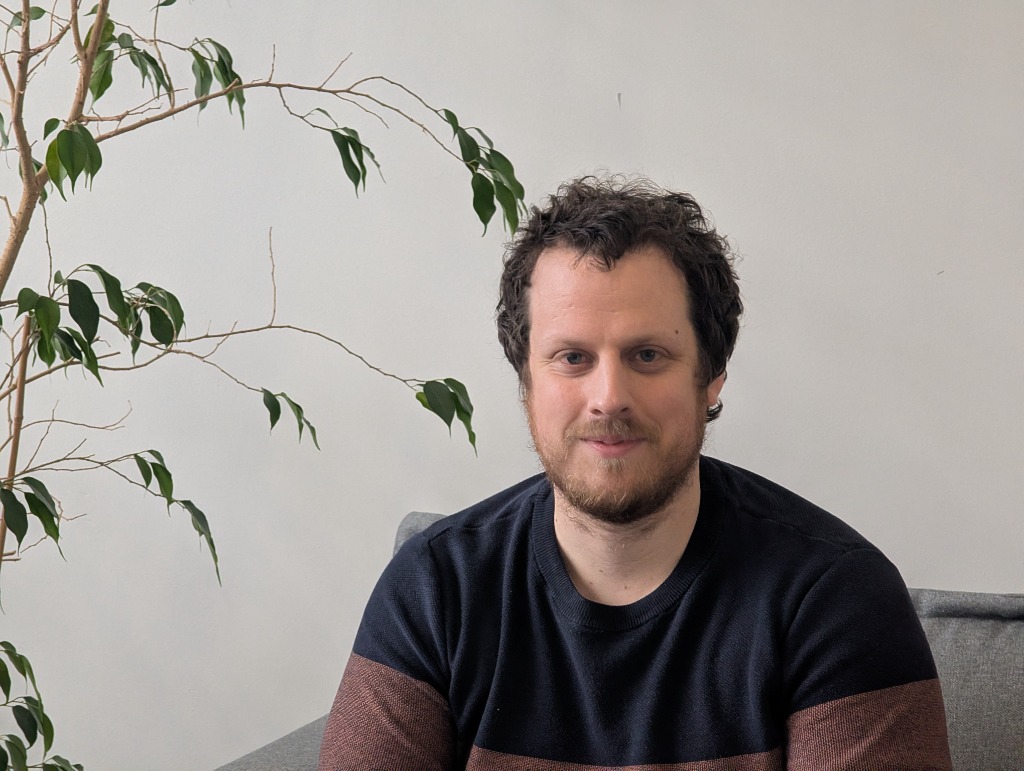
We sat down with Stef to talk about his work with LiDAR technology and how it helps keep railways safe and efficient.
Kapernikov: Hi Stef! Thanks for taking the time to speak with us. Could you start by introducing yourself and telling us a bit about your job?
Stef: Hi! I’m Stef, and I’ve been working at Kapernikov for about two years now. For the last year, I’ve been working as a project manager on LiDAR projects. I handle both the project management side and the technical side.
Kapernikov: You mentioned LiDAR projects. What exactly is LiDAR?
Stef: LiDAR is a sensor that allows us to measure the environment and display it in 3D as a collection of points—a point cloud. Based on these measured points, we develop algorithms for Infrabel to determine where vegetation is located and where cables are hanging in relation to the tracks.
Kapernikov: So, it builds a 3D image of the railway environment. What are the applications for this?
Stef: We have two main projects with Infrabel. The first one is about vegetation management. We use the point cloud to identify where the tracks are and where the vegetation is. This allows us to predict risks—for example, if a specific tree were to fall, would it hit the overhead lines? That would be a serious incident causing major delays. The goal is to prevent that using LiDAR data. It’s a form of predictive maintenance.
Kapernikov: And what does Infrabel do with this information?
Stef: They can use it to plan pruning. Or, if the vegetation isn’t on their land, they can contact the owner to request maintenance. We also calculate a severity score so they can prioritize the most critical areas.
Kapernikov: You mentioned a second element you’re working on?
Stef: Yes, the other part is for the overhead line service. They want to know exactly where the overhead line hangs in relation to the track and if it’s positioned correctly to avoid problems. The cable isn’t always centered over the track; it zig-zags from left to right so that the pantograph (the device on the train that collects power) wears evenly. If the cable stayed in one spot, it would cut through the pantograph quickly.
Kapernikov: And you can calculate that with your technology?
Stef: Exactly. We measure how far left or right the cable is relative to the track, so they can analyze if the distribution is correct. We also measure the height to ensure it’s within standards—not too high or too low. With this data, they can also simulate scenarios, such as checking if crossing cables come too close to each other when they sag during hot weather.
Kapernikov: Are there other measurements?
Stef: We’re also working on a “digital twin” of the cables. This helps with maintenance safety. If a maintenance train is working in an area, they need to know which cables might be live and dangerous. We can identify which sections of the electricity grid need to be switched off to work safely.
Kapernikov: That sounds crucial for safety.
Stef: Definitely. It helps prevent accidents that could otherwise have lead to large delays.
Kapernikov: And I heard something about “the gauge”?
Stef: Yes, the clearance envelope (gabarit) is basically the space available. We check the maximum size of an object that can be transported over a track. We analyze the space around the track between two locations to see where objects (like platforms, tunnels, or vegetation) come close to the track. This ensures that exceptional transports can pass safely without hitting anything.
Kapernikov: How often are these point clouds recorded? Is it real-time?
Stef: It’s not real-time. Usually, there are campaigns twice a year where they measure large parts of the network. The data is processed by Infrabel and the sensor operators, and then our algorithms pick it up for automatic analysis.
Kapernikov: That must be a huge amount of data.
Stef: Ideally, it covers thousands of kilometers of track. The volumes are indeed massive—I believe around 14 Terabytes for the whole network.
Kapernikov: What do you find most challenging about your job?
Stef: Currently, the technical side is the most challenging. It’s one thing to identify points as “a track” in a cloud, but applying algorithms to accurately recognize the precise shape of the rail is complex. We need high precision.
Kapernikov: And what do you enjoy the most?
Stef: Also the technical aspect! It’s rewarding to start with a raw point cloud and extract actionable information that helps prevent train delays. It’s a nice mission.
Kapernikov: What is your background?
Stef: I studied Civil Engineering with a specialization in Electrical Engineering. It was good preparation because we had a lot of software courses, which helps for this job, and the electrical background is useful when analyzing overhead lines.
Kapernikov: It’s great that you understand both the bits and bytes and the physical technology behind it. Thanks for the interview, Stef!