
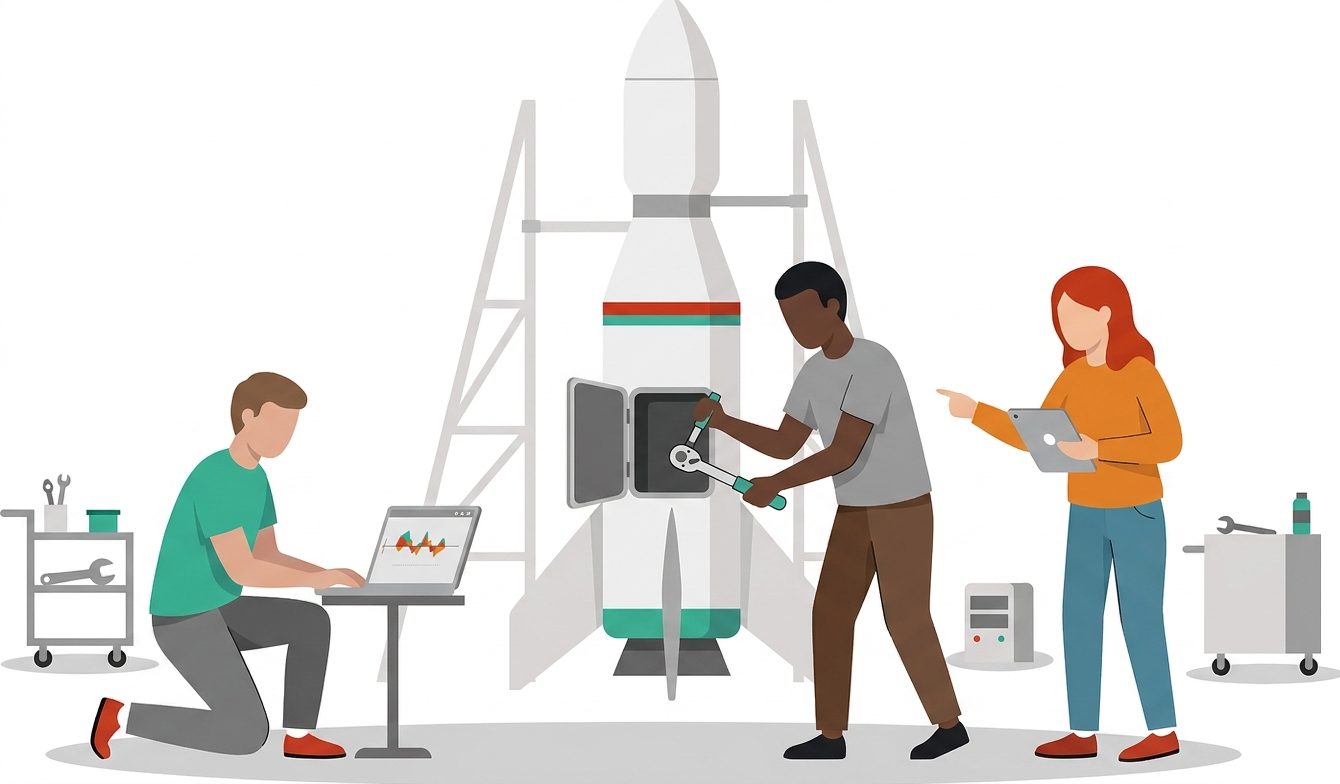
Co-creation for teams adopting emerging technology.
You’ve decided the technology matters. You’ve read the papers, watched the demos, talked to peers. You know your industry will look different in three years. Your team is good. None of them have built this before. Hiring the specialists takes nine to eighteen months. Internal pilots stall at “cool demo, now what?”.
The gap isn’t conviction. It’s the running start.
The symptoms are familiar. Pilots that impress nobody because they don’t touch production data or real workflows. A year of vendor evaluations and slide comparisons, zero code shipped. One enthusiastic engineer burning out while the rest of the team waits for direction.
What co-creation actually means
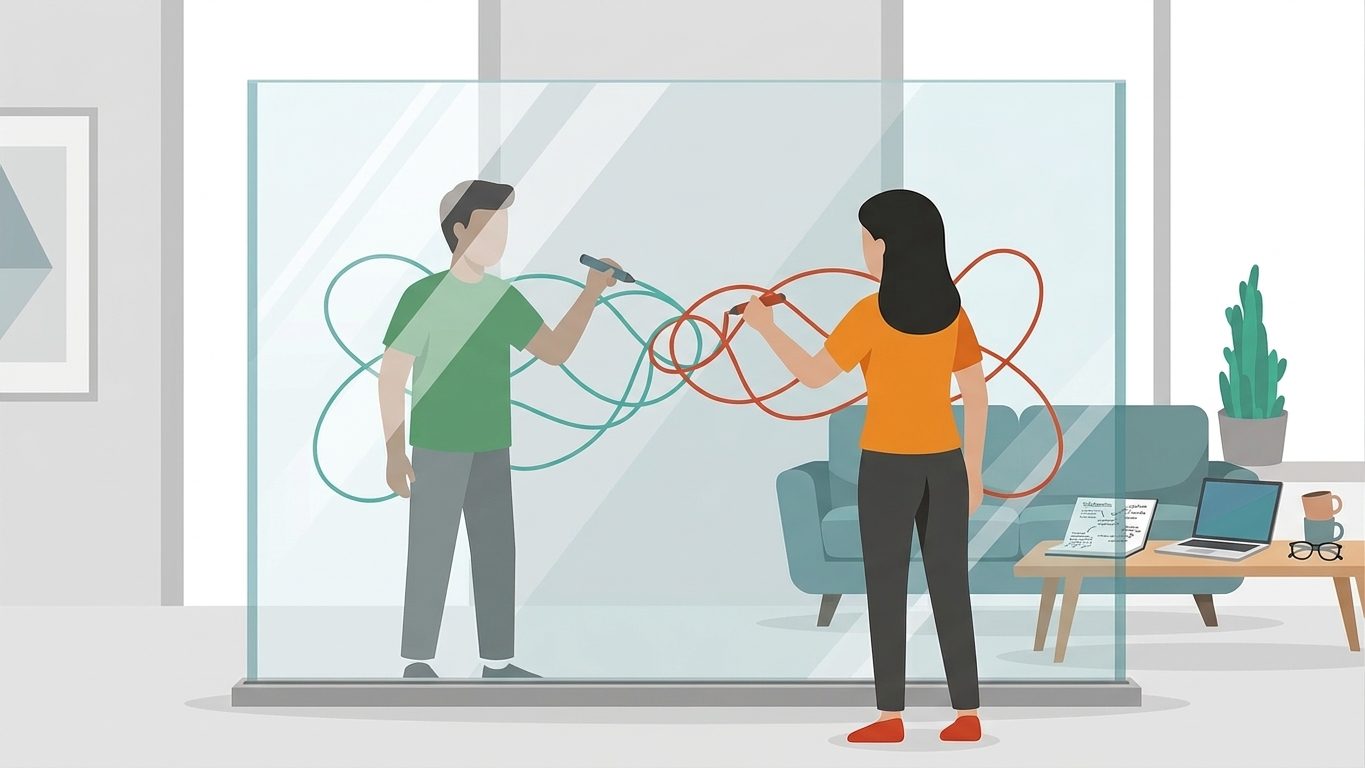
We walk in with momentum. Your team walks out with capability.
Co-creation is an operating model. In practice:
- Your engineers pair with ours from day one. Not handoff. Parallel work.
- Architecture decisions happen in the open. Trade-offs are visible; the “why not” is written down next to the “why”.
- Your people write code alongside us, review ours, and push back. Documentation is a deliverable, not an afterthought.
- The goal from kickoff is simple: when we leave, your team runs this.
You get the solution, the skills to maintain it, and the capability to keep moving once we’re gone.
When co-creation makes sense
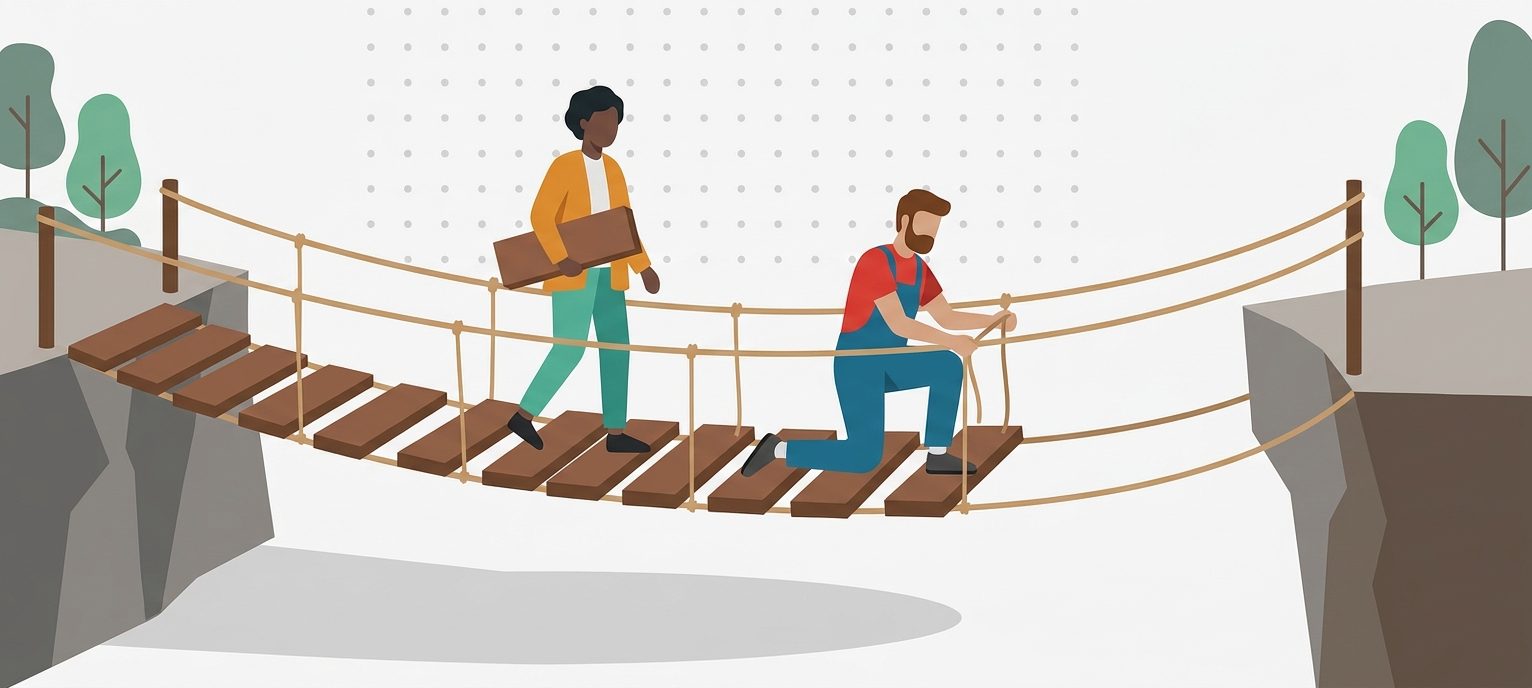
Not every project needs co-creation. A commodity build with a clear spec and no domain coupling does not. Hands on a keyboard for work your team could do themselves: also no. Co-creation is the right model when you’re crossing into new territory, and emerging technology has a particular shape that makes it so.
The specialists are rare and expensive. Hiring them takes nine to eighteen months. When you finally land one, they’re isolated inside a team that hasn’t done this before.
Best practices aren’t stable yet. Buying a playbook from a big consultancy gets you last year’s answer. You need people doing this work now, not people who wrote a methodology three years ago.
The learning curve is the deliverable. For a commodity build, knowledge transfer is a nice-to-have. Here it’s the point. Your team has to come out the other side of the curve, not just hold the output.
Sunk-cost and lock-in risk is real. Go too deep with the wrong vendor, or the wrong off-the-shelf product, and you own a system that fits the vendor’s stack instead of yours. Co-creation builds inside your environment, against your constraints, with your people in the room.
How it works
Small, paid, low-risk first step. Real result. Expand. Reversible at each step.

1. Readiness assessment. Days, not weeks. We look at what you have, what’s realistic, and which use case should come first. You leave with a prioritised portfolio and architecture options. Not a 40-page deck.
2. Foundation unlock. We connect the data or plumbing every use case needs. First visible result.
3. One end-to-end workflow. One concrete problem, solved in production, with a measured outcome. “Three weeks of expert work becomes three hours.” This is the moment the rest of the organisation starts paying attention.
4. Strategic review. Your leadership decides what comes next, with real experience instead of slides. Priorities look different once a team has seen the technology work on their own data.
5. Scale and embed. You pick the mix: more workflows, deeper architecture, or our Champion Program, where two or three of your people co-build with us on real projects for four to six weeks and leave as your internal experts.
A few things stay non-negotiable across all five steps. Named people on our side, not “resources”. Your team in the room for architecture decisions. Clear IP boundaries: you own project deliverables, generic building blocks are licensed to you non-exclusively, your data stays yours. The pause button always works. You can stop after any step and keep everything built so far.
Three cases, three sectors

GEOxyz: machine learning on sensor data
GEOxyz is a Belgian hydrographic survey company. The ambition: senior surveyors processing three to five times more data with the same team. Manual interpretation replaced by machine learning in the loop. Experts moving up the stack to validation and edge cases.
The targets were concrete. Automated boulder detection on multibeam sonar and bathymetric data, accurate enough to trust in production. A repeatable ML pipeline, retrainable as new survey data arrives. MLOps infrastructure their own team could operate, monitor, and extend. Domain expertise kept in the loop, so the model reflects how surveyors actually reason about the seabed rather than acting as a generic detector.
Off-the-shelf marine AI did not exist at this specificity. Kapernikov brought the ML methodology and the MLOps backbone. GEOxyz brought the domain knowledge that made the model actually work. Neither side could have built it alone.
Blue-C Energy: agentic AI
Blue-C Energy is building WattsUp, an offshore wind asset management platform, around large language models and agents that take on the asset data work which traditionally drowns engineering teams in spreadsheets.
Four ambitions shaped the design. Agentic document extraction: unstructured specs, inspection reports, and design documents turned into structured asset data by LLMs. An embedded agent inside the platform, a natural-language interface alongside the GUI and API, so engineers can model offshore substations in minutes instead of waiting on a data team. Every data change first happens in a sandbox; nothing reaches production data without an explicit human-approved diff, and that consent step is architecturally enforced, not left to the agent to respect. An architecture built for agents from the start, not retrofitted. A foundation Blue-C runs themselves, so the platform evolves at their pace and not a vendor’s release cycle.
No off-the-shelf product matched this. Kapernikov started with a small architecture workshop of three sessions, which grew into a full implementation trajectory. Blue-C’s engineers now operate the platform themselves.

Infrabel Asset360: tomorrow’s asset master data
Infrabel is Belgium’s rail infrastructure manager. They set a concrete technical vision for what master data management had to become:
- Data as a stream of changes. Every update traceable back to the source system, the user, and the moment it happened.
- Full lineage for every attribute, inspectable down to the individual change.
- A configurable data model supporting complex types, able to evolve without re-platforming.
- Full GIS integration. Every asset a first-class geospatial object, not an afterthought bolted on.
- A double timeline. Valid time and transaction time, so you can ask “what did we believe, when” as well as “what was true, when”.
Off-the-shelf MDM products could not do this. Kapernikov co-built the platform inside Infrabel’s own environment: their technology stack, their security rules, their governance. Blended teams with Infrabel engineers and architects. The platform keeps adapting as Infrabel’s IT standards evolve over a multi-year contract. Infrabel’s teams run it in production; Kapernikov keeps the edge current.
Each case follows the same shape: saw a wave, couldn’t start alone, jumped with a partner, own it now.
What co-creation is not
Not staff augmentation. We’re not bodies on your floor.
Not innovation theatre. Every step produces production-grade output. Code you can ship, not demos you retire.
Not unpaid pre-sales. Every step is scoped and paid.
Not a training course tacked on at the end. Transfer is continuous, starting day one.
Not us owning your problem. You own it. We accelerate you.
Five questions for any partner
Including us. Ask every vendor who claims to co-create:
- Who on my team will be in your sprint reviews?
- Will I have working code and documentation at every milestone, or only at the end?
- Can I stop after any phase and keep what I have?
- Who owns the IP, project-specific versus generic?
- Six months after you leave, can my team ship a new feature without calling you?
If a vendor dodges any of these, the answer is not co-creation.
Start with a working session
The entry point is an assessment, measured in days rather than months. A working session, not a pitch deck. You bring the ambition and your constraints. We bring the shortest honest path from where you are to where you want to be, and the first concrete step you can take without betting the company.
Talk to us when the wave is real and the running start is what’s missing.
Kapernikov is a Brussels-based data and AI company. We co-create with engineering teams inside infrastructure, industrial, and technology organisations across Europe. Get in touch to start a working session.